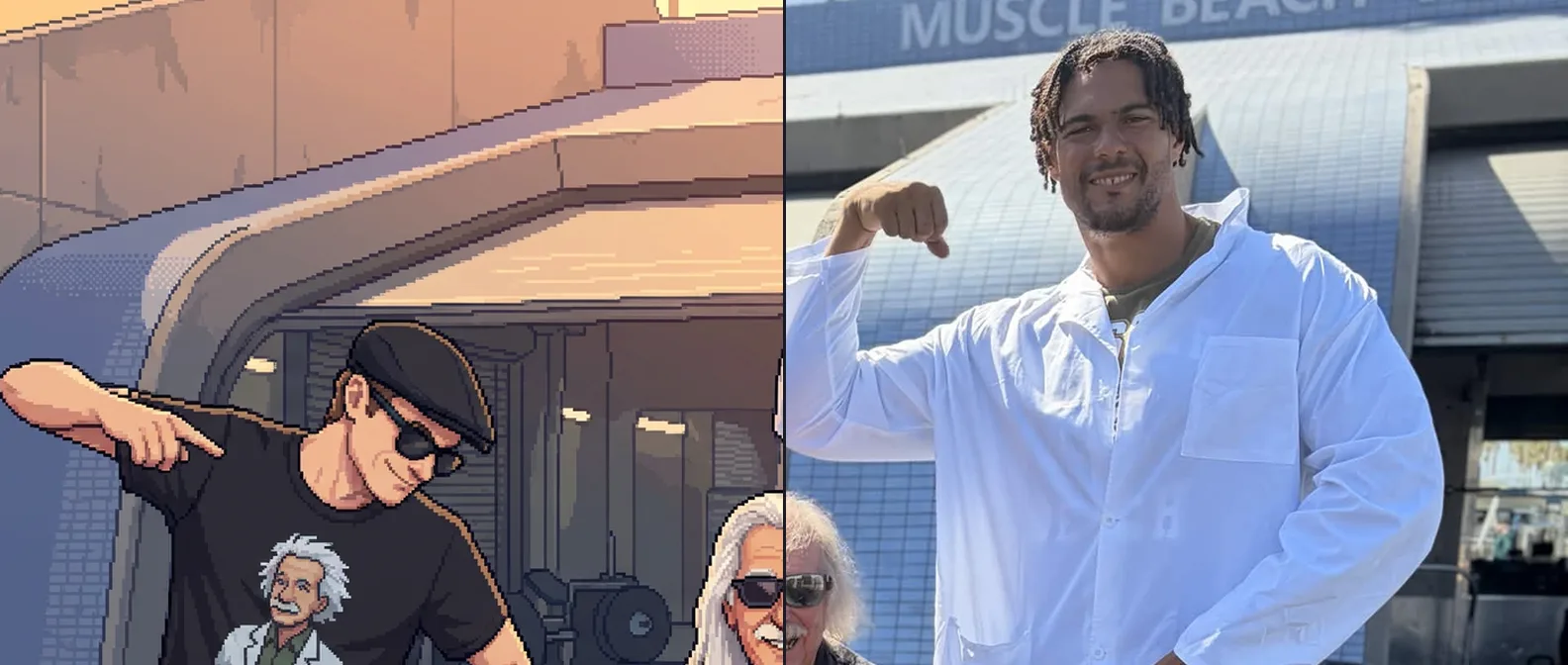
Two pictures of the same place. One is a photograph taken on a Saturday. One was drawn afterwards. Look at the trousers.
The image at the top of this page is both at once: the left half is a drawing made from the photograph, the right half is the photograph itself, and the seam runs straight through the man seated at the middle — the same person, half drawn, half real. Same people, same poses, same moment.
Start with the pants
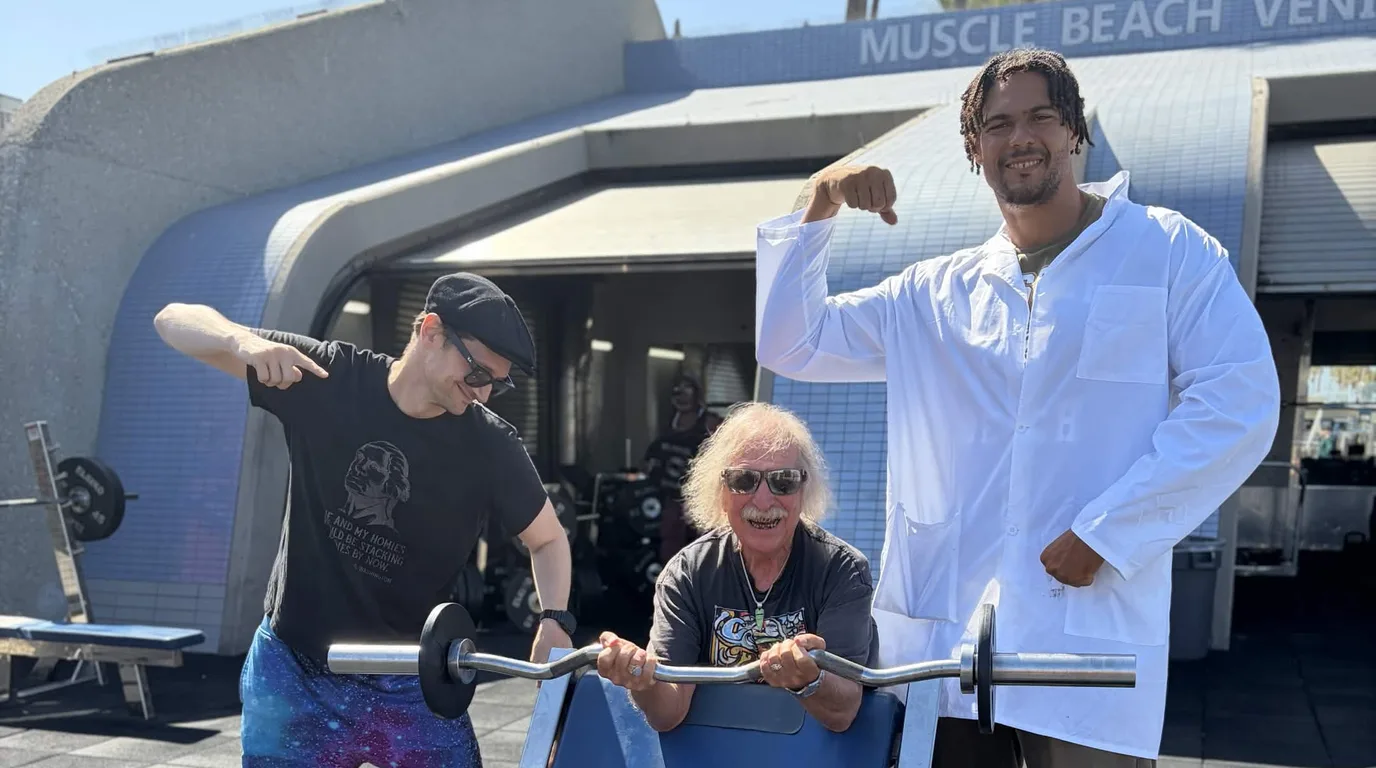
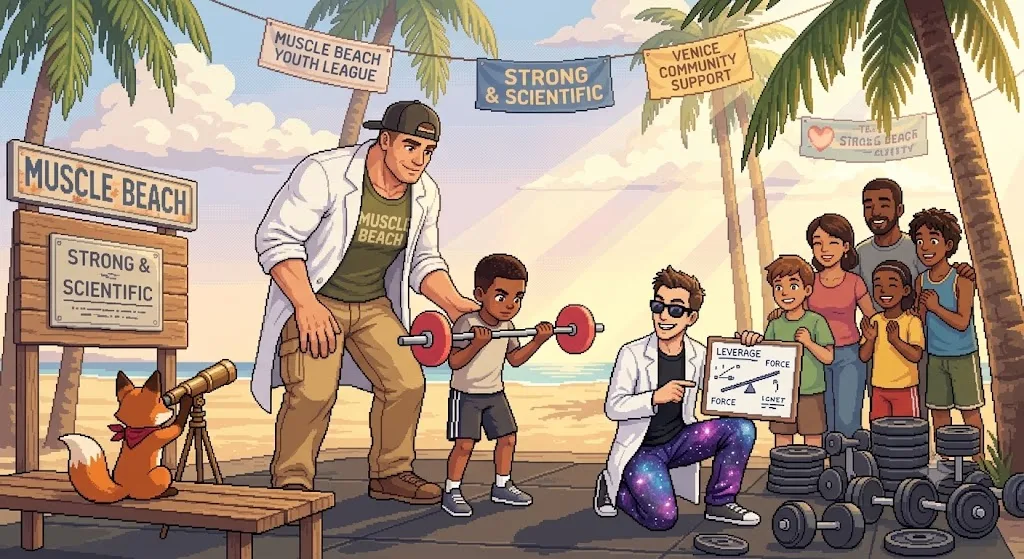
The galaxy-print trousers are in both. So is the lab coat, and the black shirt with something scientific printed on it. That is not a coincidence and it is not a style guide — it happened in the other direction. Somebody wore those trousers to an outdoor gym in Venice on a real afternoon, in front of people who were there, and the drawings came later and copied them.
That ordering is the whole point, so it is worth saying plainly: the pixel world borrows from the real one. Not the reverse.
What the two pictures actually share
Notice how little of the drawn scene is a claim about what happened. The kids are invented. The coach is invented. The fox with the telescope is, regrettably, invented. What survives the crossing from photograph to drawing is narrower and more interesting: a location you can walk to, a set of signage that exists, and an outfit somebody actually put on.
So these two images are not the same afternoon, and it would be sloppy to imply they were. They are the same place, and the same costume, in two registers — one documentary, one drawn. The drawing is an argument about what could happen there. The photograph is evidence that the argument is grounded.
Here is the second pair, which works the same way in the other direction:
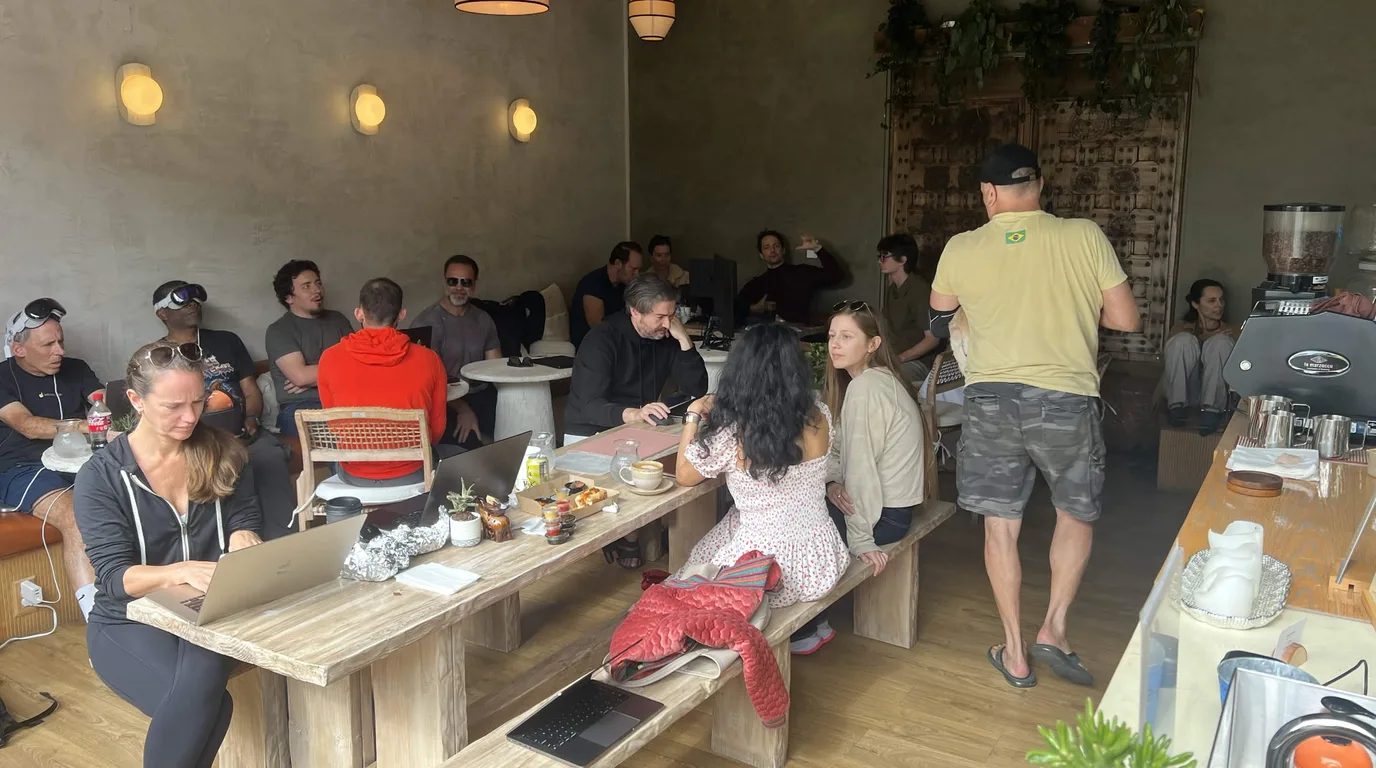

Science Sunday is a standing thing: people show up at a table and talk about what they are curious about, and nobody checks credentials at the door. The drawn version has been on this site far longer than the photograph has, and the two do not match at all. The drawing is at sunset under string lights, with a conical flask on the table. The photograph is the middle of the day, indoors, and the table is covered in laptops.
Look at what he is wearing in the drawing, though: purple turtleneck, white coat, round blue glasses. That is the standing uniform — the default. Which is exactly why the galaxy trousers in the first pair carry weight. The uniform is what gets drawn when nothing in particular happened. The costume is what gets drawn when something did.
That is the pattern worth paying attention to, and it is why these pairs are here at all. A drawn world can quietly start to feel like branding — a friendly veneer over work that may or may not exist. Putting the photograph next to it settles the question in the only way that can be settled: by showing the thing.
The layer under the pairing
There is a third pair that is not ready yet — a portrait and the pixel avatar that stands in for it — and building it turns out to be harder than the other two, for a reason that reveals something about the whole exercise. A place is easy to render faithfully. A face is not. Getting the drawn version of a person to converge on the person you would actually meet is a slower, more careful job, and doing it badly would undercut the entire claim I am making here.
So it waits. That is the honest state of it.
Come be in the record
If the pixel world is a record rather than a mascot, then the record has room in it. Every scene in it started as a Saturday somebody showed up to — a table, a platform on the sand, a room with a whiteboard. None of those required permission or a background in the field.
Science Sunday and the rest of it are open. Come sit at the table, and the drawings will catch up.
The Muscle Beach photographs and the series they belong to are described in more detail on the Stronger with Science page.