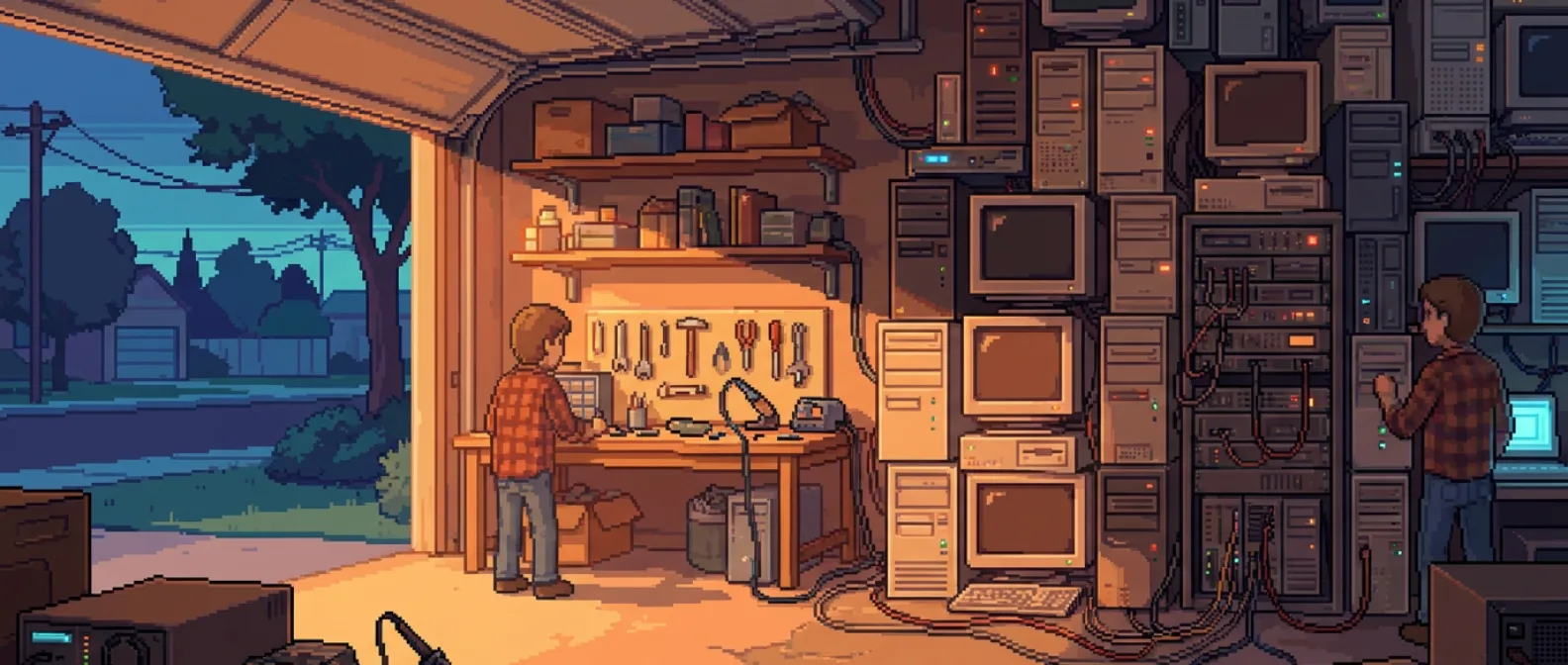
The garage in Palo Alto was a working garage long before I got to it. My dad and my grandfather would be out in the driveway with the hood of the family pickup propped open, trading the kind of quiet, unhurried problem-solving that happens when two people have fixed the same truck a dozen times. Something’s making a noise; you find it; you fix it; you close the hood. I grew up watching that. Then I claimed a corner inside and started stacking computers against the wall.
A wall built out of what other people threw away
They were not nice computers. I’d rollerblade up Sand Hill Road — past the venture offices that would later fund half the things I’d spend my life arguing about — and go dumpster diving behind office parks for machines companies had written off. A tower with a dead drive but a good power supply. A box of mismatched RAM. Enough parts, if you were patient and a little obsessive, to bring one more machine back to life and add it to the stack.
I want to be clear about what kind of story this is. It is not a prodigy story. Nobody handed me a scholarship or a lab. It was a tinkerer story — hands-on, curious, resourceful, exactly the thing I’d absorbed from the driveway. The difference was that my engine was a wall of secondhand computers, and I hadn’t yet figured out what to point it at.
What the wall was actually doing
Then I found Folding@Home, and the wall got a purpose.
Here’s the idea, in plain terms. Proteins are the machines of biology, and a protein only works once it folds itself into the right three-dimensional shape. When that folding goes wrong, you get disease — a lot of it, from neurodegeneration to certain cancers. Simulating how a single protein folds is staggeringly expensive; you’re modeling physics on thousands of jittering atoms. No one lab had enough computers to do it at scale. So the project, out of Stanford, did something clever: it chopped the problem into tiny pieces and shipped them out to anyone with a machine and some idle time. You ran a small program, your computer folded its little slice of the problem while you slept, and it sent the answer home.
My wall was a few of those machines. A kid in a garage, donating borrowed compute cycles to a disease-research project he would never see the end of — and feeling, for the first time, that a pile of junk hardware could be aimed at something that mattered.
The instinct that never changed
That’s the whole seed, really. Get compute. Point it at problems that matter. I didn’t have the words for it at the time, and I definitely didn’t have a plan. But the instinct was already there, and it turned out to be the most durable thing about me.
It didn’t come from nowhere. My grandfather — also named Stanley Bishop — was a community pharmacist in that same town, the person who remembered your name and your medication and your kid’s birthday. He put expertise in the service of the people right in front of him, one prescription at a time. I was doing a clumsy, teenaged version of the same thing: putting a wall of salvaged computers in the service of a problem I couldn’t have explained but somehow trusted was worth the electricity.
Same thing, bigger wall
Years later — after a math PhD, after getting sick and spending years misdiagnosed, after a stint building AI systems at Google — I ended up building Lattice Protocol: federated research infrastructure so that a rare-disease researcher anywhere can reach real compute and real data without waiting on permission or a grant cycle. The design requirement, stated plainly, is one sentence: compute should never be rare for rare disease researchers.
If you squint, it’s the garage wall again. Take computing power that would otherwise sit idle or locked away, and organize it toward the problems most likely to be left behind. The scale changed. The mission never did. I’m still basically doing the thing I was doing with a stack of dumpster-dived towers against a garage wall — getting compute to help people — except now the wall is a network, and the problem it’s pointed at is the one that came for me too.